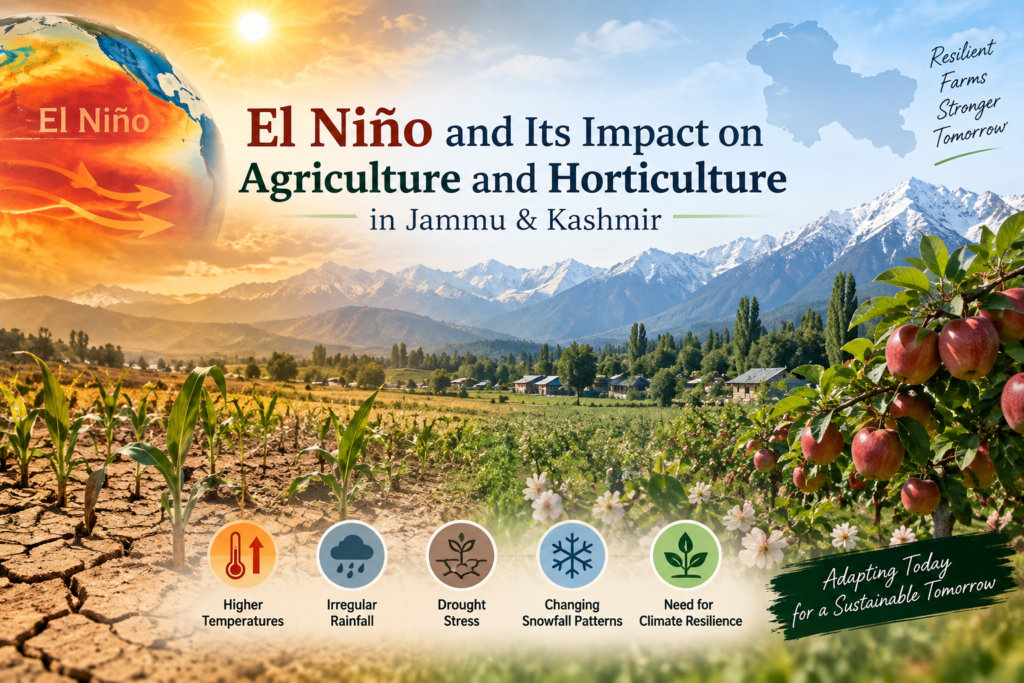
When climate variability meets a fragile farming landscape
Agriculture and horticulture in Jammu & Kashmir are closely linked with temperature, rainfall, snowfall and the availability of water. The region’s diverse landscapes, from the subtropical plains of Jammu to the temperate valleys and higher elevations, make its farming systems productive but also sensitive to changes in weather. In recent years, farmers have increasingly experienced unusual temperature patterns, irregular rainfall, intense precipitation events, dry spells, floods and landslides. These events highlight an important question: how can agriculture remain productive when weather conditions are becoming increasingly uncertain? One of the climate phenomena that attracts considerable attention in this context is El Niño.
What is El Niño?
El Niño is a naturally occurring climate phenomenon associated with abnormal warming of sea-surface temperatures in the central and eastern tropical Pacific Ocean. Through large-scale atmospheric interactions, El Niño can influence weather patterns far beyond the Pacific, including the Indian monsoon.
Historical Indian Metrological Department (IMD) data showed that the El Niño years have often been associated with below-normal Indian summer monsoon rainfall, although the relationship is not uniform in every year or every region. The IMD records show an all-India monsoon rainfall departure of -12.7% in 2015, a moderate El Niño year, while the 1997 strong El Niño year had a near-normal seasonal departure of +0.2%. This illustrates why El Niño should be considered an important climate influence rather than a simple predictor of rainfall in every location. For Jammu & Kashmir, the consequences of climate variability are particularly important because agriculture depends on a combination of rainfall, snowfall, irrigation, soil moisture and mountain water resources.
Rising Temperature and Horticulture
Temperature changes can have major implications for temperate horticulture crops. Apple, pear, cherry, walnut and almond require specific temperature conditions during their annual growth cycle. Changes in winter temperatures can alter the accumulation of chilling hours, potentially affecting dormancy release, flowering and fruit development. At the same time, warmer conditions during the growing season can increase crop water requirements and intensify heat stress. The importance of horticulture to Jammu & Kashmir is substantial. According to the J&K Government’s Regional Digest of Statistics 2024-25, the area under major fresh-fruit crops was approximately 88,487 hectares in 2024-25. Apple alone accounted for about 21,791 hectares. The sector is also undergoing technological transformation. The J&K Economic Survey 2025-26 reports that the area under major horticultural crops increased to about 3.47 lakh hectares by November 2025, while production had increased by 12.50% compared with 2021-22. The area under high and medium density plantations had also expanded substantially. These figures underline why climate-related risks to horticulture deserve serious attention.
Heat, Water Stress and Field Crops
Climate variability can affect field crops through both heat stress and water stress. Rice, maize and wheat may experience reduced productivity when temperatures become unfavourable during their sensitive growth stages. Higher temperatures can also increase evapotranspiration, due to which crops require more water to maintain their growth. For the farmers who dependent on rainfall for their crop growth, an extended dry period can therefore create moisture stress. On the other hand, rainfall arriving in a short and intense burst may cause runoff, soil erosion, waterlogging and crop damage rather than effectively replenishing soil moisture. This is one of the major challenges of climate variability: more rainfall does not necessarily mean more usable water for crops.
Floods and Flash Floods: A Growing Agricultural Challenge
The 2026 monsoon has highlighted the vulnerability of Jammu & Kashmir to intense rainfall, cloudbursts and flash floods. During July and August, several areas experienced heavy rainfall events that damaged agricultural land, standing crops and infrastructure. In Rajouri, flash floods damaged agricultural fields along streams and rivers, affecting crops such as paddy and maize and causing soil erosion and loss of fertile land.
Across the Jammu division, prolonged heavy rainfall also affected agricultural areas. A report published by Amar Ujala on 22 August 2026, citing an Agriculture Department assessment, reported that approximately 3,500 hectares of cultivated land in the Jammu division had been affected between 19 July and 19 August 2026. Paddy, maize and vegetable crops were among those affected, with particularly severe damage reported in Kishtwar and Ramban. Flooding can erode fertile topsoil, submerge crops, wash away seeds and nutrients, damage irrigation systems and cause severe soil erosion. In hilly areas, flash floods and landslides can even destroy cultivated land. These events highlight the need to strengthen agricultural preparedness for extreme rainfall and flooding alongside other climate-related risks.
Looking Ahead
The future of agriculture in Jammu & Kashmir will depend not only on increasing production but also on building resilience against uncertainty. The region has strong agricultural and horticultural potential, but this potential must be supported by climate-smart technologies, better water management, healthy soils, protected watersheds, improved infrastructure and timely scientific advisories. Importantly, not every extreme weather event in Jammu & Kashmir should be directly attributed to El Niño. Climate is influenced by multiple interacting factors, and individual rainfall or flood events require event-specific meteorological analysis. The experience of 2026 nevertheless reinforces the need to prepare agriculture for a future in which weather variability can create both water scarcity and excessive rainfall risks. The message is clear: climate resilience is no longer an optional component of agriculture it is becoming an essential part of sustainable farming.
Author: Dr. Renuka Founder & Editor-in-Chief, Agri-Hub Jammu